Welcome. I am a fifth-year PhD Candidate in Finance at Brandeis
University.
My research builds at the intersection of empirical asset pricing, financial economics and econometrics. My job-market paper develops a multidimensional framework for assessing factor robustness. My other projects investigate the timing and economic sources of factor returns.
Two Heads Are Better Than One: t-Statistics and Monotonicity in the Factor Zoo
Job Market Paper
Sole-authored
Abstract
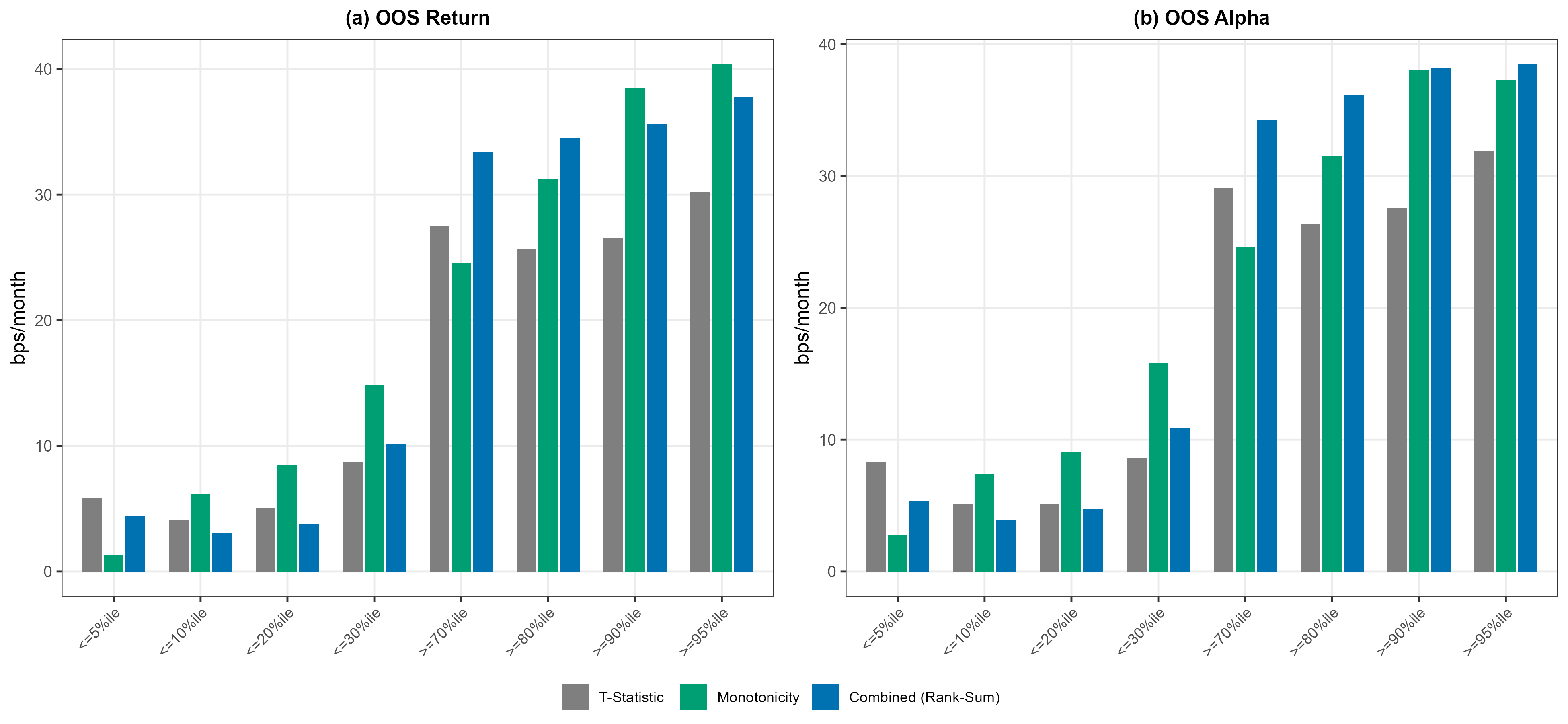
This paper shows that two in-sample diagnostics used to judge factor quality the conventional t-statistic and monotonicity capture distinct information and enhance predictive power when combined. The two measures are nearly un-correlated in-sample (ρ = −0.08). Factors with the highest in-sample summed rank across both dimensions (≥70th percentile) deliver 33.4/34.2 bps/month in out-of-sample return/alpha, while factors with the lowest summed rank (≤30th percentile) deliver only 10.2/10.9 bps/month. High-summed-rank factors also perform better in real-time trading: a strategy built on the top 30% by summed rank dominates on a certainty-equivalent basis at every risk-aversion level considered and continues to hold up once trading costs and market impact are priced in. Finally, the combined strategy results in higher diversification in factor rotation.
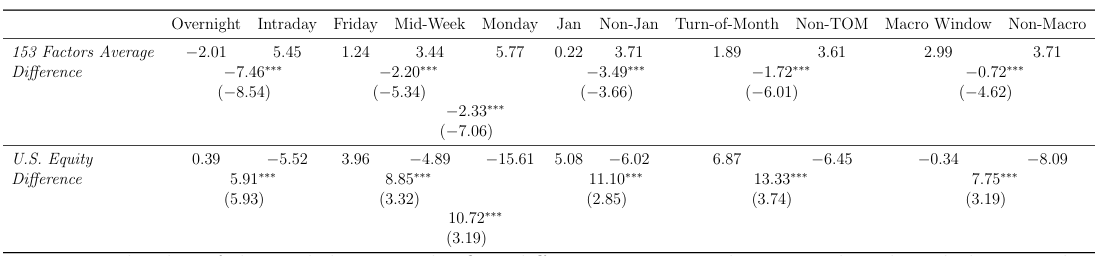
The literature finds that U.S. equity returns are higher overnight, on Fridays, in January, around the turn-of-the-month, and during macro announcements (e.g., FOMC, GDP, NFP, and ISM releases). We replicate 153 long–short factors and find that their premia are lower in all of these periods. On average, a factor loses 2.01 bps overnight but earns 5.45 bps intraday (t = 8.54); earns 5.77 bps on Mondays, 3.44 bps on midweek days, and 1.24 bps on Fridays (midweek−Monday difference: t = −7.06; Friday−midweek difference: t = −5.34); earns 0.22 bps in January but 3.71 bps on non-January days (t = 3.66); earns 1.89 bps during turn of-the-month days versus 3.61 bps on other days (t = 6.01); earns 2.99 bps during three-day windows surrounding major macroeconomic announcements, compared with 3.71 bps on other days (t = 4.62). The results are robust in-sample and out-of-sample. Our results are consistent with sentiment-driven mispricing, as we find that the calendar effects of factors are stronger when news sentiment is high.
Presented at:
Chinese Economists Society (CES) China Annual Conference 2026
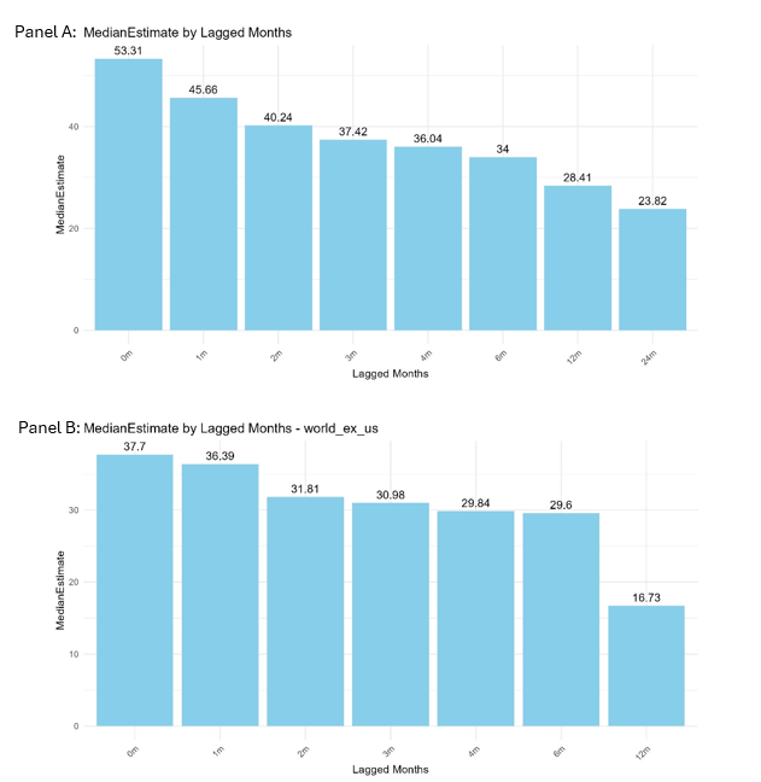
Anomaly returns concentrate around information releases, suggesting mispricing that is corrected as news arrives. We replicate 94 accounting-based anomalies with accounting data lagged by up to five years. Alpha decays slowly: median monthly CAPM alphas are 36 basis points at the four-month lag and 28 with year-old data, robust out of sample and positive internationally. An equal-weighted book of year-old factors earns 19 basis points monthly (𝑡 = 4.9); the four-month minus-twelve-month spread earns 8 (𝑡 = 6.0) and is shrinking. The evidence limits explanations in which returns vanish once information is public and is consistent with a persistent characteristic premium.